
Summarize this blog post with: ChatGPT | Perplexity | Claude | Grok
You probably wash your face before bed and maybe apply a cream—but that alone isn’t enough for healthy, glowing skin. Most people miss the correct order and key ingredients that actually repair skin overnight. In this guide, you’ll learn the exact step-by-step night skin care routine that dermatologists recommend for real results.
Key Takeaways
- Night skin care routine is a structured sequence of steps performed before sleep to cleanse, repair, and hydrate the skin.
- Skin naturally repairs and regenerates at night, making it the best time to use active ingredients.
- Effective routines follow a simple order: cleanse, treat, and moisturize.
- Product selection should match individual skin type and concerns for optimal results.
- Consistency in a minimal routine delivers better results than complex, inconsistent regimens.
- Overusing active ingredients can damage the skin barrier and cause irritation.
- A personalized routine improves hydration, texture, and long-term skin health.
What Is a Night Skin Care Routine?
Night skin care routine is a sequence of steps performed before sleep to cleanse, treat, and repair the skin.
First, this routine focuses on removing impurities like dirt, oil, and makeup accumulated during the day. For example, if you wear sunscreen or makeup, skipping cleansing can clog pores and cause breakouts overnight.
Moreover, a nighttime skincare routine involves cleansing, applying targeted treatments, and moisturizing to support overnight skin regeneration. This makes it fundamentally different from daytime skincare, which focuses more on protection.
At the same time, consistency in a simple skincare routine is more effective than using multiple products inconsistently. For example, using just cleanser, serum, and moisturizer daily often gives better results than a 10-step routine done irregularly.
Why Night Skin Care Routine Matters
Night skin care routine matters because the skin enters repair mode at night, making it more responsive to treatments and hydration.
First, skin repair increases at night, with higher cell turnover and improved product absorption during sleep — Source: Dermatology Experts, 2025
For example, research shows that skin cell renewal is nearly 30% higher at night compared to daytime — Source: Journal of Investigative Dermatology, 2024
Moreover, blood circulation improves and collagen production increases while you sleep. This means your anti-aging products, like retinol or peptides, work more effectively at night.
In addition, about 65% of people with skin conditions experience worse symptoms at night, making hydration and repair even more important — Source: Eucerin, 2025
As such, a well-structured routine can:
- Repair daily damage
- Boost collagen production
- Reduce acne and pigmentation
- Strengthen the skin barrier
What Is the Correct Order of a Night Skin Care Routine?
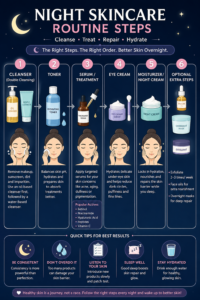
The correct order of a night skin care routine is cleanse → tone → treat → moisturize → protect (optional).
Step 1: Cleanser (Double Cleansing)
First, cleansing removes dirt, oil, and pollutants from your skin.
Double cleansing involves using an oil-based cleanser followed by a water-based cleanser to remove makeup, sunscreen, and impurities effectively.
For example, if you wear heavy makeup, oil cleansing dissolves it while a gentle cleanser cleans your pores
Step 2: Toner
Second, toner balances your skin’s pH and prepares it for better absorption.
For example, a hydrating toner with hyaluronic acid can instantly boost moisture levels.
Step 3: Serum / Treatment
Third, serums target specific skin concerns like acne, aging, or dullness.
For example:
- Retinol → reduces wrinkles
- Niacinamide → controls oil
- Vitamin C → brightens skin
Step 4: Eye Cream
Next, eye cream hydrates delicate under-eye skin and reduces dark circles.
For example, caffeine-based creams can reduce puffiness overnight.
Step 5: Moisturizer / Night Cream
Then, moisturizer locks in hydration and strengthens the skin barrier.
For example, ceramide-based creams repair dryness and improve texture.
Step 6: Optional Steps
Finally, optional steps include:
- Exfoliation (2–3 times/week)
- Face oils
- Overnight masks
For example, exfoliation helps remove dead skin and improves product absorption.
How Should a Night Skin Care Routine Change for Different Skin Types?
A night skin care routine should be customized based on your skin type to address specific concerns effectively.
Routine for Oily Skin
First, oily skin needs lightweight, non-comedogenic products.
- Gel cleanser
- Niacinamide serum
- Oil-free moisturizer
Routine for Dry Skin
Second, dry skin needs intense hydration.
- Cream cleanser
- Hyaluronic acid serum
- Thick moisturizer
Routine for Sensitive Skin
Third, sensitive skin requires gentle products.
- Fragrance-free cleanser
- Soothing ingredients like aloe vera
- Barrier-repair moisturizer
Routine for Combination Skin
Finally, combination skin needs balanced care.
- Gentle cleanser
- Targeted serums
- Lightweight moisturizer
Which Ingredients Work Best in a Night Skincare Routine?
The best ingredients for a night skincare routine include retinol, hyaluronic acid, ceramides, and peptides.
First, retinol boosts collagen and reduces fine lines.
Second, hyaluronic acid hydrates deeply.
Third, ceramides repair the skin barrier.
Fourth, peptides support skin regeneration.
For example, using retinol at night is safer because it increases sun sensitivity during the day.
What Are the Most Common Night Skincare Mistakes to Avoid?
Common night skincare mistakes include over-exfoliating, using too many products, and skipping cleansing.
First, overusing active ingredients can damage your skin barrier.
For example, combining retinol and exfoliating acids can cause irritation.
Second, skipping cleansing can clog pores and lead to acne.
Third, inconsistent routines reduce effectiveness.
Tools, Products & Practical Night Routine Examples
Practical night skincare routines simplify implementation and improve consistency.
Simple Beginner Routine
|
Step |
Product Type |
Example Purpose |
|---|---|---|
|
1 |
Cleanser |
Remove dirt |
|
2 |
Serum |
Treat concerns |
|
3 |
Moisturizer |
Hydrate skin |
Advanced Routine
|
Step |
Product |
Benefit |
|---|---|---|
|
Cleanser |
Gel/Oil |
Deep cleanse |
|
Toner |
Hydrating |
Prep skin |
|
Serum |
Retinol |
Anti-aging |
|
Eye Cream |
Caffeine |
Reduce puffiness |
|
Moisturizer |
Ceramide |
Repair barrier |
What’s Next: How to Build Your Personalized Night Routine
Building a personalized night skincare routine involves identifying your skin type, choosing targeted ingredients, and staying consistent.
First, identify your skin type and concerns.
Second, choose 2–3 effective products instead of many.
Third, follow the correct order every night.
For example, if you have acne-prone skin, use salicylic acid and a lightweight moisturizer consistently.
Conclusion
Night skin care routine is the foundation of healthy, glowing skin because it supports repair, hydration, and long-term improvement.
Ultimately, you don’t need a complicated routine to see results. By following a simple, consistent process, you can transform your skin over time.
So start tonight. Build your routine step by step—and let your skin do the rest while you sleep.
Written by Sunny Kushwaha founder of PaperHosp, researching and writing health content using trusted sources including WHO publications, government health portals, and hospital/medical institution websites.
Disclaimer: This article was initially drafted using AI assistance. However, the content has undergone thorough revisions, editing, and fact-checking by human editors and subject matter experts to ensure accuracy.